Wellness Corner: Are you ignoring your second heart?
Key Highlights
- Dental clinicians face high rates of fatigue and body pain due to impaired venous return from prolonged sitting or static standing—not just “normal” job stress.
- The calf muscle pump, known as the body’s “second heart,” plays a critical role in moving blood back to the heart and preventing leg heaviness, swelling, and exhaustion.
- Simple, frequent calf raises during the workday can restore circulation, reduce fatigue, and support long-term vascular and musculoskeletal health.
We learn anatomy and physiology in school, but we rarely explore concepts like musculoskeletal design or circulation beyond TMJ functioning, pharmacological effects of anesthesia administration, or periodontal pathways to disease. We report body pain at astonishing rates of up to 91%,1 and chronic fatigue seems to be a corequisite for a dental degree.2 Yet many of the fatigue-related symptoms clinicians normalize at the end of the day—leg fatigue, swelling, heaviness, low-back tension, and even overall exhaustion—are all uniquely tied to one overlooked system: venous return from the lower body.
The unsung hero? Your calf muscles. Just imagine the amount of gravitational force the body must overcome to return blood from the feet back up to the brain. The anatomic heart has the sole responsibility of sending life-providing blood to every cell in the body and back, 24 hours a day, 7 days a week, for many decades. But even Batman had Robin.
The “second heart”
The calf muscle pump is referred to as the “second heart” of the body. The calf muscles (primarily the gastrocnemius and soleus) surround deep veins in the lower leg. Every time they contract, they compress those veins and push blood back toward the heart. One-way venous valves prevent backflow, allowing blood to move efficiently against gravity. This miraculous mechanism is essential to circulation in (upright) humans, and, therefore, the calves are often referred to in physiology as a “peripheral heart” or “second heart.”3 It’s not a poetic exaggeration—it’s a functional reality.
When the calf pump is active, circulation improves. When it’s inactive, blood pools. We see the results in daily walkers.4
Why are dental clinicians at risk for decreased venous return?
Dental work is highly cognitive in nature and creates a perfect storm for calf pump dysfunction due to prolonged sitting or static standing for long periods of time without position changes or microshifting.
The symptoms are less than obvious as they are typically dismissed as “part of the job,” but if paid attention to, one might notice:
- Heavier legs
- End-of-day swelling
- Increased varicose veins
- Greater cardiovascular strain over time
- Generalized fatigue that isn’t “just work stress”
What’s the solution?
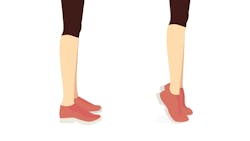
The most effective solution for maintaining a healthy second heart is simple and easy to do: calf raises. Calf raises require no equipment, no change of clothes, no dedicated workout time, and no gym membership—just intentional movement.
The calf raise movement:
- Rise fully onto the balls of the feet.
- Lower slowly (this is key).
- Keep knees soft and posture tall.
- Breathe normally.
- Repeat 10-15 times if possible.
Among all the other “just real quick” tasks we have, it can seem daunting to add another. But the beauty of calf raises is that they fit easily into the dental day during activities like morning huddle, taking a pano or CBCT, waiting for a late or slow-moving patient, or during computer/phone work. Ten slow calf raises take less than 20 seconds. Repeated throughout the day, they restore circulation, reduce fatigue, and support long-term vascular and musculoskeletal health.5
We often frame ergonomics as spine-centric, but circulation is equally critical for career longevity. Strong calves don’t just support walking and balance. They reduce lower-extremity fatigue, support spinal unloading, improve recovery between patients, and decrease long-term vascular stress. This is not fitness; it’s foundational physiology.
Your calves are already working to support your career. Training them, even in tiny doses, helps them do that job better. And sometimes, the smallest habits create the biggest shifts in how our bodies feel at the end of the day.
Editor’s note: This article first appeared in Clinical Insights newsletter, a publication of the Endeavor Business Media Dental Group. Read more articles and subscribe.
References
- Hayes MJ, Cockrell D, Smith DR. A systematic review of musculoskeletal disorders among dental professionals. Int J Dent Hyg. 2009;7(3):159-165. doi:10.1111/j.1601-5037.2009.00395.x
- Gorter RC, Storm MK, te Brake JH, Kersten HW, Eijkman MA. Outcome of career expectancies and early professional burnout among newly qualified dentists. Int Dent J. 2007;57(4):279-285. doi:10.1111/j.1875-595x.2007.tb00133.x
- Padberg FT, Johnston MV, Sisto SA. Structured exercise improves calf muscle pump function in chronic venous insufficiency. J Vasc Surg. 2004;39(1):79-87. doi:10.1016/j.jvs.2003.09.036
- Delis KT, Azizi Z, Stevens RJ, Wolfe JH, Nicolaides AN. Optimum intermittent pneumatic compression stimulus for lower-limb venous emptying. Eur J Vasc Endovasc Surg. 2000;19(3):261-269. doi:10.1053/ejvs.1999.1047
- Stewart JM, Montgomery LD. Regional blood volume and peripheral blood flow in postural tachycardia syndrome. Am J Physiol Heart Circ Physiol. 2004;287(3):H1319-H3127. doi:10.1152/ajpheart.00086.2004
About the Author
 Katrina Klein, RDH, CEAS, CPT
Katrina Klein, RDH, CEAS, CPT
Katrina Klein, RDH, CEAS, CPT, is a 19-year registered dental hygienist, national speaker, author, competitive bodybuilder, certified personal trainer, certified ergonomic assessment specialist, and biomechanics nerd. She’s the founder of ErgoFitLife, where she teaches that ergonomics and fitness are a lifestyle to prevent, reduce, and even eliminate workplace pain.