Your dental practice may be invisible to AI, and here’s what you can do about it
Key Highlights
- AI-driven search makes clear, accessible website information increasingly important for helping patients find your dental practice.
- Simple website basics—contact options, appointment booking, emergency services, and clear service information—can reduce patient friction.
- A quick 15-minute website check can uncover gaps that may prevent prospective patients from reaching and choosing your practice.

A patient-first website check for the age of AI-assisted discovery
A patient in your community has a toothache at 10 p.m. Instead of searching through a list of dental practices, they ask an AI assistant to help them find a nearby dentist who handles emergencies. Another patient wants an implant consultation. Someone else wants to know which local dentist accepts their insurance. As more patients use AI tools to help answer these types of questions, there is a new consideration for dental practices: Will your practice be among the answers they receive?
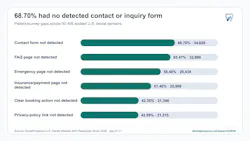
Increasingly, that may depend on how easily search engines, AI tools, and ultimately patients can find and understand the information on your website. A nationwide audit of 50,405 US dental practice websites1 suggests there is plenty of room for improvement. No contact or inquiry form could be detected on 68.70% of the websites, no clear way to book an appointment was detected on 42.35%, and no emergency-services page (the very information that patient with a toothache at 10 p.m. might be looking for) was detected on 58.40%. These are not exotic technical failures. They are everyday basics that can determine whether a motivated patient ever reaches your front desk.
The stakes are rising because the way patients find a dentist is changing. A prospective patient may search Google, ask an AI assistant for a nearby dentist, or simply click a recommendation from a friend. The path differs, but the question is the same: Can the patient quickly tell whether your practice is right for them and take the next step? AI systems do not necessarily experience your website the same way a patient looking at your home page does. They rely on information they can access and interpret about your practice, and if that information is difficult to access, unclear, or incomplete, emerging discovery tools may have a harder time understanding what your practice offers.
The good news is that addressing these issues does not require chasing every new technology or learning a new technical vocabulary. The goal, and the theme of everything that follows—including a 15-minute self-check you can run this week—is much simpler: Make your practice easy to reach, easy to understand, and easy to choose, whether a patient arrives through a search engine, an AI answer, or a direct visit.
AI visibility starts with patient access
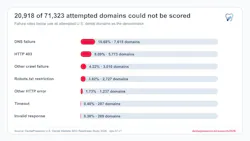
AI tools are becoming another way people research local services, yet appearing in a traditional search result does not automatically mean a website is easy for every system to retrieve and summarize. In the same study, a bounded non-Google crawler could not complete 29.33% of attempted dental-practice domains. The reasons included unreachable domains, access blocks, and crawler restrictions.
That finding does not prove that any individual practice is absent from a particular AI tool, and it does not measure Googlebot access. Instead, consider it a prompt to check for a potential blind spot. If a website provider has set security rules that unintentionally block legitimate crawlers, a practice may be harder for emerging discovery tools to understand. More importantly, those settings may signal that no one is regularly checking whether the site is accessible from outside the office.
The conversation with a website provider does not need to be technical. Ask whether the site is publicly reachable, whether important pages are accidentally being blocked, and whether practice information can be read without a special login or unusual browser setup. The provider can handle the technical details while the practice owner makes sure there is a clear answer.
Make it easy to reach
Being visible only matters if it leads somewhere useful. More than two-thirds of audited sites had no detectable contact or inquiry form, and more than four in 10 offered no clear booking action. From a patient’s perspective, that creates friction at exactly the wrong moment. They have found your practice and are interested enough to contact you, but now they have to hunt for a phone number, open several menus, or figure out what to do next.
Look at your home page on a phone and consider what a patient sees in the first screen or two. Can they call, request an appointment, or find directions without searching? Is that next step visible on service and location pages as well? If your practice prefers calls to online scheduling, say so clearly and make the number tap-to-call. The best path is the one a patient can complete with confidence.
Make it easy to understand
Patients often arrive at a dental practice website with a specific need, whether it is a sudden toothache, a child who needs a first visit, an implant consultation, or a question about insurance. If the website does not plainly explain what you offer, who you serve, and where you are located, patients may leave before they ever contact the office.
Emergency information provides a useful example. An emergency-services page was not detected on nearly six in 10 audited sites. That does not mean those practices do not provide emergency care, because a bounded crawl may not find every page. However, it is worth considering the experience of someone searching for urgent help at night. Can that patient quickly determine whether to call your practice, where to go, and what to expect?
Ask your provider to review each core service page for plain-language explanations, current office and location details, and answers to common patient questions. Clear content serves people first while also giving search and AI systems more reliable information to work with.
Make it easy to choose
A patient who can find your practice and understand what you offer still has to decide whether to choose you. A useful website reduces that uncertainty by explaining services, introducing the team, making practical information easy to locate, and offering an obvious next step. Small gaps can compound, and a missing appointment prompt, unclear insurance information, or hard-to-find emergency guidance can turn a motivated visitor into a lost opportunity.
The answer is not adding more jargon or building a longer home page. It is removing friction and making sure each page helps a real person answer three basic questions: Is this practice relevant to me? Do I understand what happens next? Can I act now?
How to check your site in 15 minutes or less
You do not need to inspect code or learn technical terms to get a sense of how well your website is doing. Set aside 15 minutes and experience the site the way a prospective patient would.
- Search for your practice name and visit the site on your phone.Confirm that the home page loads promptly and that the phone number, directions, and appointment path are easy to find.
- Choose three common patient needs.For example, try a dental emergency, a new-patient visit, and one major service. Starting from the home page, see whether you can reach useful information for each in just a few taps.
- Try the contact or booking action yourself.If the form is confusing, the scheduler breaks, or no confirmation is provided, write down the exact point where the experience becomes unclear.
- Send your website provider the issues you found.Ask for a plain-language response about what will be corrected, who owns it, and when it will be rechecked. Include the question about accidental public-access or crawler blocks.
The AI conversation can feel abstract, but the solutions are grounded in everyday patient service. A practice that is easy to reach, easy to understand, and easy to choose is in a stronger position no matter how a patient discovers it.
Disclosure: Aditya Kale is the founder of DentalPresence, the organization that conducted and published the study cited in this article.
Reference
- What 50,405 U.S. dental websites reveal about SEO readiness. DentalPresence. 2026. Accessed August 12, 2026. https://dentalpresence.in/case-studies/us-dental-website-readiness-2026
About the Author
 Aditya Kale
Aditya Kale
Aditya Kale is the founder of DentalPresence, which conducted and published the 50,405-site US dental website readiness study cited in this article. His work focuses on helping practices understand observable website visibility, accessibility, and patient-conversion signals. Contact him at [email protected].