GoTu survey data: Income satisfaction is higher with temp work, but so is burnout
Key Highlights
- About 1 in 8 dental professionals reported combining permanent and temporary or gig work in 2026.
- Hygienists with temp work reported higher income satisfaction—but also higher burnout and less access to PTO.
- Flexible work arrangements may be reshaping how dental professionals approach careers, recruitment, and retention.

For decades, the model of how people showed up for work in the dental industry stayed largely the same. Dentists owned and operated their practices with a steady team of front office staff and dental assistants. Dental hygienists often worked at a single location, although it was not uncommon for them to pick up a permanent part-time position at another office. To fill gaps in the schedule, practices employed temporary workers, which has long provided another option, particularly for dental hygienists and dental assistants. Recent workforce data show that some dental professionals are now combining those arrangements rather than choosing one or the other.
Survey data collection
GoTu surveyed nearly 8,000 dental professionals over the course of three years. In 2024, GoTu began surveying dental hygienists for its State of Work research in 2024, giving the profession three years of data through 2026. Dental assistants were added in 2025, providing two years of data, while dentists were surveyed for the first time in 2026.
In 2026, the survey improved how respondents could describe their work schedules to collect more informed data about how dental professionals are actually working. Rather than selecting only one type of employment arrangement, respondents could select multiple options, capturing those who might hold a permanent position while also working temporary or gig shifts. The expanded options provided a clearer view of how dental professionals are putting together their workweeks. Let’s dig into that number.
Related: Why are hygienists turning to temping?
Flexible work schedules vs. burnout
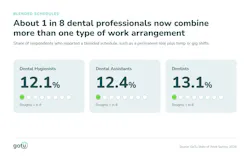
In 2026, 12.1% of dental hygienist respondents reported a blended schedule, compared with 12.4% of dental assistants and 13.1% of dentists (skewed toward those in their early career). With approximately one in eight respondents across all three professions combining more than one type of work arrangement, flexible work is no longer a conversation that applies only to dental hygienists or those who identify primarily as temporary workers.
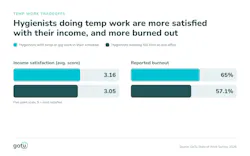
Hygienists whose current schedules included temporary or gig work reported an average income satisfaction score of 3.16 on a five-point scale, compared with 3.05 among hygienists working exclusively full time at one office.
Burnout moved in the opposite direction, with 65% of hygienists currently involved in temp work reporting burnout compared with 57.1% of those working exclusively full time at one office. Burnout trends across the three years tell a more complicated story and will be examined more closely in the next article in this series.
Compensation and benefits
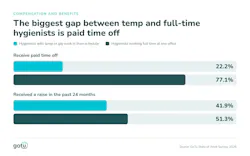
Compensation and benefits provide additional context for how these work arrangements differ. Among hygienists with current temp involvement, 41.9% reported receiving a raise within the previous 24 months compared with 51.3% of those working exclusively full time at one office. Paid time off showed a much larger difference, with 22.2% of hygienists involved in temp work reporting PTO compared with 77.1% of hygienists working exclusively full time at one office.
Higher income satisfaction existing alongside higher burnout, fewer recent raises, and less access to paid time off makes it difficult to measure the value of flexible work through any one metric. A dental professional may place greater value on income, schedule flexibility, or control over when and where they work while accepting fewer of the benefits that can be associated with permanent employment. Compensation and benefit trends also changed over the course of GoTu’s surveys and will be explored separately in this series.
How dental professionals view their careers
How dental professionals choose to work may also be connected to how they view their careers. Hygienists working blended schedules reported slightly higher intent to remain in dental hygiene long term, although the difference was not statistically significant. The findings provide another reason to consider temporary and blended work as more than something dental professionals do while looking for a permanent position. For some, combining different work arrangements may simply be how they choose to build a career in dentistry.
For practices competing for employees, these findings expand the conversation around recruitment and retention. Hourly compensation remains an important part of employment decisions, but dental professionals may also be considering schedule flexibility, benefits, stability, workplace experience, and control over when and where they work. Understanding how employees prioritize those factors becomes more important when greater satisfaction in one area, such as income, does not necessarily translate to greater satisfaction across the rest of their work experience.
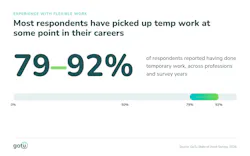
GoTu’s survey population is particularly familiar with flexible work. Across professions and survey years, 79% to 92% of respondents reported having performed temporary work at some point. (Note: This is for assistants and hygienists only.) Their experience provides a view into a segment of dentistry that has already had considerable exposure to different ways of working and may offer an early look at how dental professionals are combining permanent and temporary employment.
The improved 2026 survey gives GoTu a new workforce measure to follow as these working arrangements continue to evolve. Future surveys can build on the nearly identical blended-schedule rates among hygienists, dental assistants, and dentists to better understand not only how dental professionals are working, but what they are looking for when they choose those arrangements. For practices trying to recruit and retain their teams, those answers may ultimately be as valuable as knowing what employees expect to be paid.
About the Author
 Cass Miller
 Cass Miller
Cass Miller is the director of advocacy and community at GoTu, the largest dental workforce platform in the US. She leads community-driven programs and advocacy initiatives that support, uplift, and recognize dental professionals while strengthening connections across the industry. Passionate about creating spaces where the dental community feels seen and supported, Cass focuses on building programs that empower professionals, amplify their voices, and help shape a more connected, sustainable future for dentistry.