Air polishing requires its own standard of care
Key Highlights
- Air polishing carries distinct risks from traditional rubber cup polishing, including the potential for subcutaneous emphysema and soft-tissue injury.
- Differences in dental hygiene and dental assisting education highlight the importance of procedure-specific training, clinical judgment, and competency assessment.
- State practice acts should distinguish air polishing from coronal polishing and prioritize patient safety when considering expanded dental assisting duties.
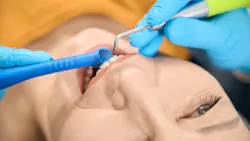
Patients settling into a dental chair trust that the person treating them has the education and clinical judgment necessary to provide safe care. That trust should guide decisions about whether dental assistants may operate air polishing equipment. As states consider expanding delegated duties, policymakers should recognize that air polishing and traditional rubber cup polishing are distinct procedures. Sharing the word “polishing” does not make their mechanisms, risks, or educational requirements interchangeable.
Rubber cup polishing vs. air polishing
Rubber cup polishing uses a rotating cup and polishing paste to remove surface deposits and stain. Air polishing delivers a pressurized stream of air, water, and powder. That difference is important: pressurized air can enter soft tissues, creating a complication that requires prompt recognition and assessment. State practice acts should therefore define air polishing separately rather than automatically including it within an existing authorization for coronal polishing.
Related: Who are state dental boards really meant to protect?
Air polishing complications
Subcutaneous emphysema—the introduction of air into tissues—is an uncommon but serious complication of air polishing. In a published report describing three patients, all developed emphysema involving the face and neck, and one experienced extension into the mediastinum, the space between the lungs. All recovered, but their experiences demonstrate that a procedure performed during tooth or implant cleaning can have consequences extending well beyond the mouth. These reports establish a potential hazard; they do not establish how frequently it occurs.1
Soft-tissue injury also deserves attention. A clinical study examining gingival tissue found that glycine powder air polishing produced less erosion than sodium bicarbonate air polishing. This distinction underscores an essential point: air polishing is not one uniform intervention. Powder selection, equipment, treatment location, and technique matter. Although rubber cup polishing can also cause injury when performed improperly, its risks should not be treated as equivalent to those associated with a pressurized powder stream.2
Clinical decision-making
The appropriate response is careful clinical decision-making. Operators must understand the tissues they are treating, recognize conditions that warrant caution, follow device-specific instructions, and identify an unexpected reaction.
A recent case report documented emphysema after subgingival air polishing with glycine powder, reinforcing that a less abrasive powder does not eliminate the possibility of air entering tissues. The authors emphasized patient selection, adherence to equipment instructions, and early recognition of swelling and crepitus.3
Dental hygiene curricula
The Commission on Dental Accreditation’s (CODA) standards require dental hygiene curricula to include anatomy, physiology, microbiology, immunology, pathology, pharmacology, and other biomedical sciences. Required dental and clinical content includes periodontology, oral anatomy, patient management, and medical and dental emergencies. These subjects provide a foundation for evaluating patients and understanding the consequences of treatment.4
Periodontology helps clinicians interpret the relationship between disease and tissue integrity. Anatomy supports an understanding of structures surrounding the treatment site. Pharmacology and biomedical science inform the assessment of medical histories, while emergency education supports recognition and response when complications arise. This integrated preparation extends beyond learning how to position a nozzle or activate a device. Hygienists still need training on the particular equipment they use; their license alone does not replace procedure-specific competence.
Dental assisting education
Dental assistants are essential members of the dental team, and their education should be described fairly. Accredited assisting programs include foundational sciences, including anatomy, pathology, microbiology, and pharmacology. However, CODA identifies several of these subjects at a familiarity level, reflecting the profession’s different educational purpose. It would be inaccurate to say that assistants receive no scientific preparation. It would be equally inappropriate to assume that assisting education provides preparation equivalent to a dental hygiene curriculum for periodontal assessment and management.5
Furthermore, formal assisting education is not universally required. The U.S. Bureau of Labor Statistics notes that some states allow entry into dental assisting through on-the-job training without formal educational requirements. Expanded duties may carry additional requirements, but this variation makes a broad authorization especially concerning: the title “dental assistant” alone does not establish a consistent educational foundation.6
Workforce pressures and access
Workforce pressures and access concerns deserve serious consideration. They do not establish that two procedures are interchangeable or that a brief equipment course provides sufficient clinical preparation. Any proposal to expand air polishing privileges should address the procedure’s specific risks, required foundational education, supervised clinical experience, competency assessment, and emergency response expectations. Existing permission to perform rubber cup polishing should never serve as an automatic substitute.
Patient protection
The case for maintaining air polishing within the responsibilities of appropriately trained licensed dental hygienists and dentists rests on patient protection. It does not require claiming that every assistant would cause harm or that every hygienist is immune from error. It requires matching clinical responsibility with demonstrated preparation.
Patients should be able to trust that a familiar-sounding procedure has been evaluated on its actual risks. State practice acts should preserve a clear distinction between rubber cup polishing and air polishing—and place patient safety ahead of administrative convenience.
Editor’s note: This article first appeared in Clinical Insights newsletter, a publication of the Endeavor Business Media Dental Group. Read more articles and subscribe.
References
- Alonso V, García-Caballero L, Couto I, Diniz M, Diz P, Limeres J. Subcutaneous emphysema related to air-powder tooth polishing: a report of three cases. Aust Dent J. 2017;62(4):510-515. doi:10.1111/adj.12537
- Petersilka G, Faggion Jr. CM, Stratmann U, et al. Effect of glycine powder air-polishing on the gingiva. J Clin Periodontol. 2008;35(4):324-332. doi:1111/j.1600-051X.2007.01195.x
- Hussein RM, El Rahman Amer SA, Moussa SG. Subcutaneous emphysema following subgingival polishing using an air polishing system with subgingival nozzle: a case report. Int J Dent Hyg. 2026;24(4):808-813. doi:10.1111/idh.70083
- Accreditation Standards for Dental Hygiene Education Programs. Commission on Dental Accreditation. August 8, 2025. https://coda.ada.org/-/media/project/ada-organization/ada/coda/files/dental_hygiene_standards.pdf
- Accreditation Standards for Dental Assisting Education Programs. Commission on Dental Accreditation. August 9, 2024. https://coda.ada.org/-/media/project/ada-organization/ada/coda/files/dental_assisting_standards.pdf
- Occupational Outlook Handbook. Dental assistants. U.S. Bureau of Labor Statistics. Updated October 29, 2026. https://www.bls.gov/ooh/healthcare/dental-assistants.htm
About the Author
 Bethany Montoya, MBA, RDH
Bethany Montoya, MBA, RDH, is a practicing dental hygienist, educator, industry key opinion leader, and editorial director of DentistryIQ’s Clinical Insights newsletter. She has a passion for advancing modern disease prevention. She specializes in exploring the intersection of clinical practice, professional growth, and innovation within oral health care. Through her writing, she aims to educate, inspire, and spark meaningful dialogue in the dental community. She can be reached at [email protected].
Related
 Set high standards in your dental hygiene practice.
 dentals-performing-dental-hygiene