BOOTH CAMP: Measuring reaction, takeaways, & visitor action
By Jack J. Phillips, PhD
In the previous column, published in the July issue, we discussed measures taken for the exhibit activity and process — level zero in our measurement system. In this column, we examine the first three outcome measures: reaction, learning (exhibit takeaways), and application (visitor action), levels one, two, and three in our system, respectively.
Level 1 Reaction: The perceptions about the exhibit, the experience, and the information
It is important for the visitors to react favorably to the exhibit. Many veterans in this field will tell you that if the reaction is not positive, nothing will happen from the booth visit. The potential for sales is lost. Although a perception, this first level of outcome is critical. The exhibit team needs to decide the specific reaction visitors should have. Should visitors see a professional organization? An industry leader? An organized process? An attractive exhibit? A helpful staff? Timely information? Helpful handouts? Valuable give-aways? If so, these perceptions can be measured in a variety of ways. Most often, they're measured in the form of surveys. Some surveys are collected immediately from a sample of visitors.
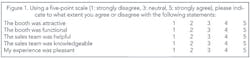
The individuals are asked to rate the booth and sales team on a scale of one to five, with one being the worst and five being the best (see figure 1).
In other situations, the data could be captured in a survey that is sent to a sample immediately after returning from the conference. The response rate will be very low.
Level 2 Learning: What visitors learn from the booth visit
Often referred to as "the message," this level of measurement captures the visitor takeaways from the exhibit (knowledge and information). This is more valuable than measuring reaction. If we are introducing a new product, do visitors understand the product and the message that goes along with it? If we have a new product strategy, do the visitors know it? If the service agreement has been upgraded, do the visitors understand it? If we are trying to change the current image, do the visitors understand it? This is measured with the reaction and evaluated with a short survey, immediately at the exhibit, electronically through a follow-up email, or through a web-based survey. A follow-up survey can be used along with other levels of data that will be described later.
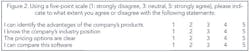
In the ADA example, data from levels one and two could be collected in a sample of participants visiting the booth. Using a simple survey on a clipboard, approximately 20% of the visitors are asked to complete it as they leave the booth and are provided a small gift for doing so, valued around $5 (see figure 2).
Level 3 Application: The actions taken by booth visitors
Application is the desired actions a visitor should take. A successful booth visit ideally turns into an action of some sort by that visitor. This is more valuable than measuring learning. Ultimately, we want visitors to buy something (impact), but there is usually another step between learning (the message) and impact (the sale). This application could be any of the following:
• Visit our website
• Request a demo
• Read a product profile
• Contact a reference
• Contact a satisfied customer
• Read a brochure
• Use a coupon
• Agree to a sales call
• Schedule a free briefing
• Compare our products with others
• Contact an independent third party for comments (ratings)
• Read a briefing paper
• Visit our facility
• Use a product on a trial basis
• Try a free sample
It is helpful to determine which of these actions are important and set objectives for them. Maybe there are four or five key objectives that define what we want visitors to do. The measures will come later. Some are in the system (automated for follow-up); others are validated by the sales team. Still others may be obtained in a questionnaire or a phone call.
Measuring the extent to which the actions have been achieved is more involved because it is a follow-up evaluation. Unfortunately, exhibit teams are not always motivated to do the follow-up. The field sales staff is often assigned the responsibility to follow up, but unless they are convinced that this will generate significant sales, they may not do it. The challenge is to have a disciplined approach to follow-up, at least with specific conferences.
The next column will focus on measuring impact, the most desired measures for executives.
Jack J. Phillips, PhD, is a world-renowned expert on accountability, measurement, and evaluation. Phillips provides consulting services for Fortune 500 companies and major global organizations. The author and editor of more than 50 books, he conducts workshops and presents at conferences throughout the world. His expertise in measurement and evaluation is based on more than 27 years of corporate experience in the aerospace, textile, metals, construction metals, and banking industries. He is chairman of the ROI Institute, Inc., and can be reached at 205.678.8181 or by email at [email protected].