What is the real reason patients choose one dentist over another?
What you'll learn:
- Why the patient decision is largely made before anyone picks up the phone, and what your digital presence is communicating right now.
- Which specific trust signals carry the most weight when prospective patients evaluate your practice online.
- Practical steps you can take immediately to strengthen your practice's authority without a full rebrand.

Most dentists assume patients choose based on two things: how close you are and whether you take their insurance. Those factors matter, but they rarely decide the outcome. In a market where several practices are equally convenient and in-network, something else tips the scale. That something is authority.
Not authority in the traditional sense, as in a wall full of degrees and years in practice. The kind of authority that says, quietly and convincingly, "people trust this place." It gets communicated through dozens of small, mostly digital signals before a prospective patient ever calls your front desk.
Understanding this shift is what separates practices that consistently attract new patients from those stuck wondering why their schedule stays half-full despite having excellent clinical skills and a beautiful office.
The decision happens before the call
Here is what patient behavior actually looks like today. Someone searches "dentist near me" on their phone. Within a few minutes, they have landed on two or three Google Business Profiles, glanced at your website, scanned a handful of reviews, and formed a gut-level opinion about your practice. By the time they decide to call, the decision is essentially already made. Your job is to win that evaluation phase, and that requires deliberate attention to your dental reputation management strategy across every channel a prospective patient might encounter.
The challenge is that most practices have never audited what that experience actually looks like. They have a website, some reviews, maybe an Instagram page, and assume that is enough. It often is not, and the gap between a practice that feels authoritative and one that feels average shows up immediately to anyone evaluating both.
What patients are actually looking for
When a prospective patient lands on your Google profile or website, they are running a rapid and mostly unconscious trust evaluation. Here is what they are picking up on:
- Does this practice look current and active?
- Do other patients seem to love it here?
- Does this practice feel like it was built for someone like me?
- How easy would it be to book an appointment?
None of these are purely rational. They are emotional. And your digital presence either answers them confidently or leaves the patient uncertain enough to check the next result.
Reviews are your most powerful trust signal
Google reviews are the single most influential factor in pre-contact patient decision-making. Patients are not just counting stars. They are reading the narrative, looking for mentions of gentle care, clear explanations, and a staff that actually listened. A review that says "Dr. Reyes took time to explain my options without pressuring me" is more persuasive than any headline you can write for your homepage.
Volume matters, too. Fresh, recent Google reviews carry far more weight than an older, stagnant review total. Google ranks practices with consistent review velocity higher in local results, which means a practice generating 20 new reviews per month will often outperform a competitor with twice as many total reviews but none in the past year.
Building a repeatable system for getting more Google reviews for your dental practice does not have to feel awkward or time-consuming. A high-volume Google review profile is one of the highest-return investments a practice can make, and the process can be systematized so your team carries it consistently without it feeling like an extra task. Review recency, not just total volume, is what tells Google and prospective patients alike that your practice is active, current, and consistently delivering excellent care. Team incentives and automation can dramatically improve your visibility over competitors still relying on manual, inconsistent asks.
Your website is telling a story; is it the right one?
Your website communicates personality before it communicates anything else. The tone of your homepage copy, the photos, the color choices, the language style, all of these speak to a prospective patient's emotions before they have processed a single sentence about your services.
Consider the difference between these two homepage headlines:
"Comprehensive Dental Services for the Whole Family"
versus
"We take extra time with nervous patients and never rush you through your visit."
Both describe a dental practice. Only one is persuasive to someone who is anxious about going to the dentist, which is a significant share of your prospective patient base.
Your dental website design should be built around what patients need to feel, not just what services you offer. That means leading with outcomes over procedure names, using "you" language throughout, and addressing dental anxiety openly. And beyond the copy, it means ensuring your site is technically sound. Slow load times, broken mobile layouts, and weak on-page structure are quietly costing practices new patients every single month, often without anyone realizing it. A website SEO audit can reveal exactly where the gaps are.
Modern patients are also discovering practices in new ways. Google's AI Overviews now appear above traditional search results, synthesizing recommendations directly on the page. If your website is not structured to be selected as a source, even a top-ranking page may be invisible to patients who never scroll past the AI-generated answer. Making your website AI-friendly is no longer optional, and creating AI-ready dental content ensures that both human visitors and AI-powered search tools understand exactly what your practice offers and who it serves. The same principle applies to how AI search engines find and recommend practices, which means teaching AI to identify and surface your practice is becoming as important as traditional SEO.
Consistency across platforms closes the deal
Here is something most practices overlook. A prospective patient might find your Google Business Profile, visit your website, and then check your social media before deciding. If the visual style, tone, and messaging feel disconnected across those three touchpoints, something feels "off." They cannot always name it, but that feeling erodes trust fast.
A cohesive dental social media strategy is one of the most underestimated trust-building tools in dentistry. It is not just about posting regularly. It is about presenting the same personality, the same values, and the same level of care across every platform. When your brand is coherent and consistent, it signals that your practice pays attention to detail. Patients extend that perception to your clinical care. As AI reshapes how patients search for dental practices, consistent, text-rich social content also becomes a signal that AI-powered search engines use to understand and recommend your practice.
The booking experience is the final test
There is one more place where practices quietly lose patients who were already interested: the booking process itself. If your website has no online scheduling option, patients who arrive after hours or on weekends often just move on. If your phone goes to voicemail during business hours, that is another lost opportunity.
Online scheduling has moved from a nice-to-have to a competitive expectation, particularly for younger patients and families. Everything you have done to build authority, the reviews, the website, the consistent branding, brought a prospective patient to the point of reaching out. A frictionless booking experience converts that work into an actual appointment. Getting found by AI-powered tools and then optimizing your website so AI can index and recommend your services is part of ensuring that journey completes as intended.
The authority audit at a glance
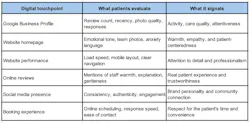
Each touchpoint is a micro-decision. Your practice earns trust or loses it at every one.
Patients do not choose a dentist the way they choose a service plan. They choose based on accumulated trust signals, the reviews that mention a kind hygienist, the website that acknowledged their anxiety, the social feed that made the practice feel real and approachable, the booking experience that did not make them wait three days for a callback. You already have the clinical skill. The opportunity is to make sure your digital presence communicates it clearly enough that patients choose you before you ever meet them. Pick one area from this article and commit to improving it this week.
FAQ
Q: Why do patients choose one dentist over another when both practices seem similar?
A: The decision almost always comes down to perceived trust rather than clinical comparisons. Patients evaluate reviews, website tone, team photos, and overall brand consistency before making contact. The practice that communicates warmth, responsiveness, and reliability across all those touchpoints wins the comparison, even when services and pricing are nearly identical. Google reviews are one of the most powerful factors in that evaluation, and practices that manage them actively have a clear competitive advantage.
Q: How much do Google reviews actually influence which dentist a patient selects?
A: They are the single strongest pre-contact trust signal most patients rely on. Patients read reviews for specific details, mentions of gentleness, clear communication, and billing transparency. Both volume and recency factor in. Building a 500-review Google profile through consistent, systematic review generation is one of the most effective things a practice can do to improve both local rankings and new patient conversion rates.
Q: What makes a dental website persuasive enough to convert visitors into patients?
A: The most impactful changes involve emotional language and authentic photography. Shift your homepage copy from listing procedures to acknowledging patient concerns and desired outcomes. Replace stock images with real photos of your actual team and office. Address dental anxiety explicitly. These changes communicate empathy and authenticity, and a well-structured dental website that is built for both patient experience and AI discoverability will significantly outperform one that focuses only on services.
Q: Why does brand consistency across platforms matter so much for a dental practice?
A: When a prospective patient encounters different visual styles, tones, or messaging across your website, Google profile, and social media, it creates subtle doubt even if they cannot identify why. That doubt often pushes them toward a competitor that feels more organized and trustworthy. Maintaining a consistent dental social media strategy aligned with your website and Google profile reinforces your brand authority and keeps prospective patients moving toward a booking rather than away from one.
Q: When should a dental practice start paying attention to online authority?
A: Immediately, regardless of how long you have been in practice. Even well-established practices lose prospective patients daily to newer competitors who have invested in their digital presence. Auditing your website for technical SEO issues, generating fresh reviews consistently, and maintaining a coherent brand across platforms are ongoing priorities, not one-time fixes.
About the Author
Danielle Caplain
Danielle Caplain is a copywriter at My Social Practice, where she crafts compelling, SEO-friendly content that helps dental practices grow their online presence and connect with patients. My Social Practice is a dental marketing company that provides comprehensive dental marketing services to thousands of practices across the United States and Canada.