Synvaza: A barrier-based approach to oral wound comfort
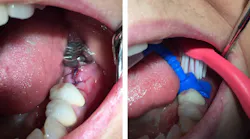
Every oral wound heals in one of two ways. A scalpel incision with approximated margins heals by primary intention, closing quickly with minimal granulation tissue whereas excisions, extraction sockets, gingivectomies, and palatal donor sites heal by secondary intention, filling with granulation tissue and re-epithelializing from the margins.
Laser wounds are hemostatic and often less painful early on, but the coagulated surface must slough before epithelium advances, so they also heal by secondary intention and can lag a scalpel incision by a few days. Aphthous and herpetic ulcers follow the same open-wound path; antivirals can shorten a herpetic episode when started early, but the ulcer still takes seven to 14 days to re-epithelialize. In every case, the healing surface sits exposed to food, friction, and the oral microbiome for days.
Leaving wounds untreated
Our usual postop tools treat the bacteria or the nerve endings, but rarely the wound itself. Chlorhexidine and oxygenating rinses reduce bioburden, but they are swished and spat, leaving the site unprotected between uses, and chlorhexidine brings staining and taste alteration. Benzocaine gels and viscous lidocaine mask pain for minutes, need frequent reapplication, and leave patients numb while eating and swallowing. Topical steroids help immune-mediated ulcers but require a prescription and are hard to keep on wet mucosa, while adhesive pastes and films are difficult to place on posterior or surgical sites. Saltwater rinses can soothe, but they neither stay nor protect.
How Synvaza goes above and beyond
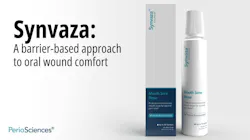
Synvaza™ Oral Wound Rinse from PerioSciences takes a different approach: protect the wound and keep it moist. It is built on ChitoTek, a glycopolymer that pairs chitosan with arginine. Positively charged chitosan adheres to the negatively charged mucosa and mucin layer, forming a thin protective film over the wound, while arginine improves moisture retention and integration with saliva. That film shields the site from irritation and contamination, maintains the moist environment that favors epithelial migration, and relieves pain by covering exposed tissue rather than numbing it. Synvaza is FDA-cleared to manage pain in oral wounds, mouth sores, injuries, and ulcers, and it is free of alcohol, parabens, sulfates, and dyes.
Success in clinical trials
In a within-subject pilot study of 25 patients with painful ulcerative and erosive lesions—including oral lichen planus, recurrent aphthous stomatitis, chronic graft-versus-host disease, and cancer-related mucositis—72 hours of use reduced overall oral soreness by 28% (p<.01). Soreness fell 67% while talking, 62% while drinking, 56% while swallowing, 51% while sleeping, and 50% while eating. Stinging averaged about two out of 10, and 75% of patients said they would use it again.1 The study was small and open-label, and controlled trials in surgical wounds would strengthen the case, but these are exactly the functional gains patients notice in the days after a procedure.
Clinically, Synvaza fits postop care after extractions, implants, grafts, periodontal and laser surgery, and biopsies, as well as denture sore spots, appliance irritation, aphthous ulcers, and supportive care for herpetic lesions alongside antiviral therapy. Patients rinse for 30 seconds in the morning and night and as needed, then wait 10 minutes before eating or drinking; after extractions, use begins once the clot-protection window has passed. It complements rather than replaces an antimicrobial rinse, and because it is sold over the counter, it adds no prescription or chairtime. Chitosan is shellfish-derived, so confirm allergy status first.
For decades we have sent patients home with a rinse that kills bacteria and a gel that numbs nerves, leaving the wound to fend for itself in between. Synvaza fills that gap. For any practice that cuts, lases, grafts, extracts—or sees patients with painful mouth sores—it deserves a place in the postop protocol.
Reference:
- Epstein JB, Villines DC, Baker S. Efficacy of a glycopolymer-based oral rinse upon pain associated with ulcerative and erosive lesions of the oral mucosa: A within-subject pilot study. Oral Surg Oral Med Oral Pathol Oral Radiol. 2018;126(3):240-245. doi:10.1016/j.oooo.2018.05.009
About the Author

Samuel B. Low, DDS, MS, MEd
Samuel B. Low, DDS, MS, MEd, is the former president of the American Academy of Periodontology and of the Academy of Laser Dentistry. He was selected Dentist of the Year by the Florida Dental Association, Distinguished Alumnus by the University of Texas Dental School, and received the Gordon Christensen Lecturer Recognition Award. He is also a former president of the Florida Dental Association and past ADA Trustee.