Wellness Corner: Red-light therapy—recovery tool, dental therapy, or expensive red lamp?
Key Highlights
- Photobiomodulation (PBM) uses red and near-infrared light to influence cellular processes, with legitimate clinical applications in dentistry.
- PBM shows promise for oral mucositis, periodontal therapy, musculoskeletal pain, and other conditions—but evidence varies by application.
- Wavelength, dose, treatment time, and delivery technique matter when evaluating whether a red-light therapy device is clinically effective.
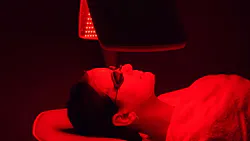
Red-light therapy seems to be everywhere. Glowing face masks promise younger-looking skin. Full-body panels promise faster recovery, less inflammation, better sleep, and improved performance. But behind the wellness-industry hype is legitimate science. Red and near-infrared light have been studied for decades under a less marketable name: photobiomodulation (PBM). And surprisingly, some of its strongest clinical applications are already found in health care—including dentistry.
What is photobiomodulation?
So, what Is photobiomodulation? PBM uses nonionizing, nonthermal light to influence biological processes within tissue. Red and near-infrared wavelengths are commonly used, with wavelength and other treatment parameters influencing how light interacts with and penetrates tissue.
One of the leading proposed mechanisms involves cytochrome c oxidase, an enzyme within the mitochondrial respiratory chain capable of absorbing red and near-infrared light. PBM may influence mitochondrial activity and transiently alter ATP and reactive oxygen species signaling, initiating downstream cellular responses. Other proposed mechanisms involve light-sensitive membrane receptors, ion channels, and extracellular signaling pathways. Importantly, researchers still do not completely understand how all these mechanisms interact.1
In other words, there is definitely more happening here than simply warming tissue under a fancy red lamp.
Related: Red light therapy: A comprehensive overview for dental professionals
Does red light actually work?
The frustrating scientific answer is it depends. PBM isn't one standardized treatment. Wavelength, irradiance, total energy delivered, treatment time, spot size, distance from the tissue, depth of the target tissue, and delivery technique can all influence the biological dose, and, therefore, the outcome. A systematic review of PBM in dentistry found substantial differences in treatment parameters and concluded that understanding dosimetry, tissue depth, optical properties, and technique is essential to achieving predictable clinical outcomes.2
Translation? Your cells don't care how expensive your red-light panel was. They care about the dose of light that actually reaches the tissue.
This may help explain why research and personal experiences seem inconsistent. “I tried red-light therapy” tells us about as much as “I took medication.” What wavelength? What dose? For what condition? How often? Those details matter.
Use of red-light therapy in dentistry
Wait … can red-light therapy be used in dentistry? Yep. One of the most established applications of PBM is the prevention of oral mucositis associated with cancer therapy. The Multinational Association of Supportive Care in Cancer and International Society of Oral Oncology (MASCC/ISOO) recommend specific intraoral PBM protocols for prevention of oral mucositis in several cancer-treatment settings, including certain patients undergoing hematopoietic stem-cell transplantation and patients receiving head-and-neck radiation therapy, with or without chemotherapy.3
Other dental applications are being investigated as well, including temporomandibular and masticatory-muscle conditions, xerostomia, burning mouth syndrome, orthodontic applications, and other oral conditions. However, evidence is not equally strong for every indication.2
PBM has also attracted attention in periodontics. A 2024 systematic review and meta-analysis of 22 studies evaluated PBM as an adjunct to basic periodontal therapy. The authors concluded that it may be a valuable adjunct in periodontitis treatment, particularly with transgingival application.4 That's intriguing, but “adjunct” is the important word. Light doesn't replace disruption of the periodontal biofilm, instrumentation, or appropriate periodontal therapy.
What about aching clinicians? This is where PBM becomes especially interesting for dental professionals. Musculoskeletal pain is precisely what sends many of us searching for massage guns, heating pads, stretching routines, supplements, ergonomic gadgets—and now, red-light panels. PBM has been investigated for musculoskeletal pain and athletic recovery, with systematic reviews reporting potential benefits in some settings.5
But PBM should be viewed as another tool in the toolbox, not an undo button.
No amount of red light eliminates excessive physical workload, inadequate recovery, poor sleep, insufficient strength, or hours spent working in sustained awkward positions. If the underlying demand continually exceeds your body's capacity to recover, shining a light on the irritated tissue doesn't remove that demand.
Recovery tool or expensive red lamp?
Potentially either. Photobiomodulation is neither magic nor automatically snake oil. There is legitimate physiology, decades of research, and established clinical use behind it. But that doesn't mean every glowing device sold online provides a clinically meaningful dose—or that every claim printed is evidence backed.
Before investing, look beyond testimonials and words like “medical grade.” Ask about wavelength, irradiance, treatment area, recommended distance, treatment time, and the evidence supporting the intended application.
Because when it comes to photobiomodulation, the question isn't simply whether red-light therapy “works.” The better question is this: What light, at what dose, delivered to what tissue, for what purpose?
Editor’s note: This article first appeared in Clinical Insights newsletter, a publication of the Endeavor Business Media Dental Group. Read more articles and subscribe.
References
- Frankowski DW, Ferrucci L, Arany PR, et al. Light buckets and laser beams: mechanisms and applications of photobiomodulation (PBM) therapy. GeroScience. 2025;47(3):2777-2789. doi:10.1007/s11357-025-01505-z
- Cronshaw M, Parker S, Anagnostaki E, Mylona V, Lynch E, Grootveld M. Photobiomodulation dose parameters in dentistry: a systematic review and meta-analysis. Dent J (Basel). 2020;8(4):114. doi:10.3390/dj8040114
- Elad S, Cheng KKF, Lalla RV, et al. MASCC/ISOO clinical practice guidelines for the management of mucositis secondary to cancer therapy. Cancer. 2020;126(19):4423-4431. doi:10.1002/cncr.33100
- da Silva RCM, da Silva LGC, Martins AA, de Araújo CM, de Aquino Martins ARL. Adjunctive photobiomodulation to basic periodontal therapy using different low-power laser application techniques: a systematic review and meta-analysis. Lasers Med Sci. 2024;39(1):207. doi:10.1007/s10103-024-04148-2
- Morgan RM, Wheeler TD, Poolman MA, Haugen ENJ, LeMire SD, Fitzgerald JS. Effects of photobiomodulation on pain and return to play of injured athletes: a systematic review and meta-analysis. J Strength Cond Res. 2024;38(6):e310-e319. doi:10.1519/JSC.0000000000004752
About the Author
 Katrina Klein, RDH, CEAS, CPT
Katrina Klein, RDH, CEAS, CPT
Katrina Klein, RDH, CEAS, CPT, is a 19-year registered dental hygienist, national speaker, author, competitive bodybuilder, certified personal trainer, certified ergonomic assessment specialist, and biomechanics nerd. She’s the founder of ErgoFitLife, where she teaches that ergonomics and fitness are a lifestyle to prevent, reduce, and even eliminate workplace pain.