Can Samsung’s new wearable help patients brush better?
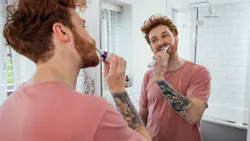
Samsung has recently filed a patent for their new dental wearable: a small device that snaps onto a user's toothbrush to help them brush better. This tool can analyze dental records—including age, missing teeth, and history with braces or gum disease—and use this data to facilitate more comprehensive brushing.
Although this patent (US 2026/0315202 A1) is currently gaining traction, it was originally filed in the spring this year.
According to a recent article by Patentlyze, “While you brush, the wearable tracks how the brush tilts, twists and presses. If your motion on a tooth drifts too far from the recommended one, the app shows you how to correct it. There's even a child mode for parents brushing a kid's teeth.”1
How this wearable works
The system works through three pieces: a phone using a health app, a wearable motion and pressure sensor, and a server for your dental records. The phone knows when the wearable is on a toothbrush due to the change in the blood-flow sensor.
Once the phone is aware you are brushing your teeth, it can go through your dental records through a server built on FHIR, a standard for sharing health records between systems.1 Other data that may be included in this wearable device includes x-rays, CT images, and even notes from a patient’s dental provider.
The ring device can also create a "pattern" for each tooth as it gathers more data on brushing habits. The app will use things such as brush tilt, twist, and pressure on surfaces to create a pattern score, if the pattern score falls below a certain threshold it will provide guidance and can advise to book a dental appointment.1
As T3 news editor Rik Henderson notes, “This could possibly also lead to an understanding on whether a tooth has shifted or changed in some way, maybe to alert you to book a dental appointment before it becomes painful.”2
What this may mean for clinicians
If successfully patented and approved for widespread use, Samsung’s new wearable can help patients take better care of their teeth at home and help remind them of brushing/dental hygiene tips from their clinician.
However, one caveat mentioned by Patentlyze is that this device only works if dental records can be accessed via a patient’s phone; as it stands, this is not standard in many clinics. If approved, the future of this ring may depend on technological compatibility, ease-of-access to patient records, and how well it can be integrated into patients’ lifestyles.
Input from one dental professional
Katrina Klein, RDH, CEAS, CPT, is an expert in ergonomics and believes an important question to ask is in regard to how accurately a device attached to a toothbrush handle can determine the pressure being applied at the tooth surface.
“Motion sensors can provide valuable information about movement and angulation, but that doesn't necessarily translate to an accurate measurement of the force being applied by the bristles,” she said. “I'd be interested in understanding how Samsung intends to measure or estimate that pressure and whether the technology has been validated across different toothbrush designs.
From an ergonomic perspective, the device's weight, dimensions, location and attachment stability on the handle are also key factors. For example, a small device placed near the gripping surface may alter finger positioning or interfere with rotation of the handle, according to Katrina.
A device farther from the hand might change the balance or rotational inertia of the toothbrush. Other concerns include grip diameter, surface texture, slipping when wet, accessibility for patients with arthritis or limited dexterity.
“We also need to consider what this technology offers beyond the feedback already available through established power brushes. Incorporating a patient's dental records into personalized brushing instruction is an interesting possibility, particularly for patients with unique anatomical or clinical considerations. However, the real measure of success will be whether the technology improves brushing effectiveness without making the task more complicated or physically demanding.”
Ultimately, technology that helps patients improve their oral health is a good thing, but as Katrina mentions, we must not to confuse sophisticated data collection with clinically meaningful outcomes, as a device that tracks brushing motion isn't necessarily measuring plaque removal.
References:
-
Samsung files patent for a toothbrush add-on that coaches you using your dental records. Patentlyze. October 22, 2026. https://patentlyze.com/patent/samsung-toothbrushing-coach-using-dental-records/
-
Henderson R. Samsung's next smart ring might not be for your finger, but something else entirely ... your toothbrush. T3. October 20, 2026. https://www.t3.com/home-living/samsungs-next-smart-ring-might-not-be-for-your-finger-but-something-else-your-toothbrush
About the Author
 Sarah Butkovic, MA, BA
Sarah Butkovic, MA, BA, is an Associate Editor at Endeavor Business Media, where she works on creating and editing engaging and informative content for today's leading online dentistry publications. She holds a Master's English Language and Literature from Loyola University Chicago and is passionate about producing high-quality content that educates, inspires, and connects with readers.
Bridget Janis
Staff Writer
Bridget Janis is a staff writer at Endeavor Business Media’s Dental Group, where she reports on clinical, industry, and public health topics for leading dental publications. She holds a bachelor’s degree in journalism from Oakland University in Rochester, Michigan, and is focused on producing clear, engaging, and informative content for dental professionals.
Related
 Smart watches
 Data Driven Dentistry