Dyson launches CameraJet electric toothbrush with built-in camera
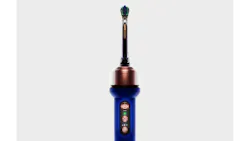
Dyson has entered the oral care market with the launch of the CameraJet, an electric toothbrush that combines a built-in camera, machine learning, and a targeted liquid jet.
The CameraJet was announced on Sept. 1, and according to the company, it spent six years researching, advancing technology, and working with 30 dental professionals globally to develop the CameraJet. The machine-learning system was trained using more than 470,000 dental images.1
Dyson has filed 38 patents for the CameraJet, according to the company’s website. The toothbrush is priced at $499.99 and is currently available on the company’s website and through select retailers in Ceramic Ultra Blue and Ceramic Pink.
The camera-guided approach
The CameraJet has a 100,000-pixel macro camera in the brush handle. The MyDyson app can provide a live viewing experience for the user and offers brushing guidance and information about coverage and technique. According to Dyson, the camera can process 28 images per second.1
The camera uses Gap Optical Targeting to identify gaps between teeth and a direct precision liquid jet while the user brushes. The camera, which is powered by machine learning, can detect, track and predict gaps in teeth in real time and provide a jet burst of mouthrinse in the area within 100 milliseconds of the camera detecting the gap.
“Dyson engineers and scientists have spent well over a decade understanding oral care regimes and how nasties build up in the mouth,” said James Dyson, founder and chief engineer of Dyson, in a press release.1 “Our research has shown that people consistently miss the areas where plaque forms: the gaps between teeth.”
Dyson stated that images captured by the camera are processed on the device and not recorded or stored in the cloud.
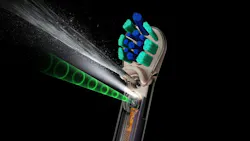
Targeting interdental spaces
The conical jet system uses a 12.5-mL reservoir and pump within an anti-gravity tank, along with a diaphragm pump and pressure chamber. Dyson claims the tank is designed to provide uninterrupted jets in any orientation.
According to Dyson, its laboratory testing found that a narrow, needle-type jet used in some water flossers can only pierce a hole through the plaque without removing it. Dyson developed a broad, conical-shaped jet that the company says achieves a wider coverage sweep at lower pressure around the gums and enamel.1
There are both automatic and manual modes.
The toothbrush comes with a non-foaming toothpaste formulated without SLS, users must use a non-foaming toothpaste for the camera to work properly, and a low-foaming mouthrinse for the precision jet. Both products contain sodium fluoride, phosphates, and xylitol. The charging dock has a tank to refill the toothbrush within three seconds.
Dual-bristle brush head
The toothbrush head moves about 1,000 times per second and uses sonic oscillation to keep the bristles moving and a sonic dampener to reduce noise. It uses a dual-bristle design, with a firmer inner bristle and a softer outer bristle to target the gumline.
According to Dyson, external testing showed the sonic oscillation removes up to 69 percent more plaque than premium electric toothbrushes in hard-to-reach places.
Each brush head uses an RFID tag to track when it is connected, monitor the number of cleaning cycles completed, and alert users when it’s time to replace the brush head. A sensitive brush head is also available.
Connectivity and customization
The toothbrush has extended features within the MyDyson app. In addition to live viewing and guidance, the app provides information about the user’s cleaning routine.
The CameraJet is Wi-Fi connected at 2.4 GHz and uses Bluetooth, Dyson stated that images captured by the camera are processed on the device and not recorded or stored in the cloud.1
Users can also customize their experience, choosing between auto-detect and manual jetting modes, and adjusting brushing intensity to their comfort level.
Considering the clinical limitations
The use of water to clean interdentally has long been part of recommended home care. What is interesting about the CameraJet is its ability to identify interdental spaces and 43`1 automatically direct a water jet toward them. From a clinical standpoint, however, identifying a gap does not necessarily mean biofilm is present or that the area has been completely cleaned. Water-based interdental cleaning also does not necessarily replace string floss, particularly around the areas just above and below the contact. So, while innovative, we need to be able to manage patients’ expectations and clearly discuss limitations.
That said, home-care recommendations have to consider what patients will realistically do. For someone doing no interdental cleaning, having it incorporated automatically into brushing could be a meaningful improvement, even if it is not the sole solution. The built-in camera and real-time feedback may also help patients recognize areas they routinely miss, although requiring specific low-foaming toothpastes and rinses for the camera to work could create a practical limitation. There is a lot that still needs to be evaluated clinically, but it will be interesting to see where camera-guided technology like this goes in this space and also beyond the toothbrush.
Clinical input from Andrew Johnston, Editor in Chief
References:
- Dyson. Dyson CameraJet: The only toothbrush with a camera and a jet, to target the gaps and remove plaque between your teeth. September 1, 2026. https://www.dyson.com/discover/news/latest/introducing-camerajet
About the Author
Bridget Janis
Staff Writer
Bridget Janis is a staff writer at Endeavor Business Media’s Dental Group, where she reports on clinical, industry, and public health topics for leading dental publications. She holds a bachelor’s degree in journalism from Oakland University in Rochester, Michigan, and is focused on producing clear, engaging, and informative content for dental professionals.
Andrew Johnston, Editor in Chief, DentistryIQ
Editor In Chief, DentistryIQ
Andrew Johnston is Editor in Chief of DentistryIQ with more than 15 years of clinical experience and over two decades of leadership experience. Known as a trusted leader in the DSO space, he brings a clinician-first mindset and a focus on sustainable growth. He values community-driven learning and is committed to amplifying diverse voices across dentistry so the profession can learn and grow together. To contribute, email him at [email protected].